

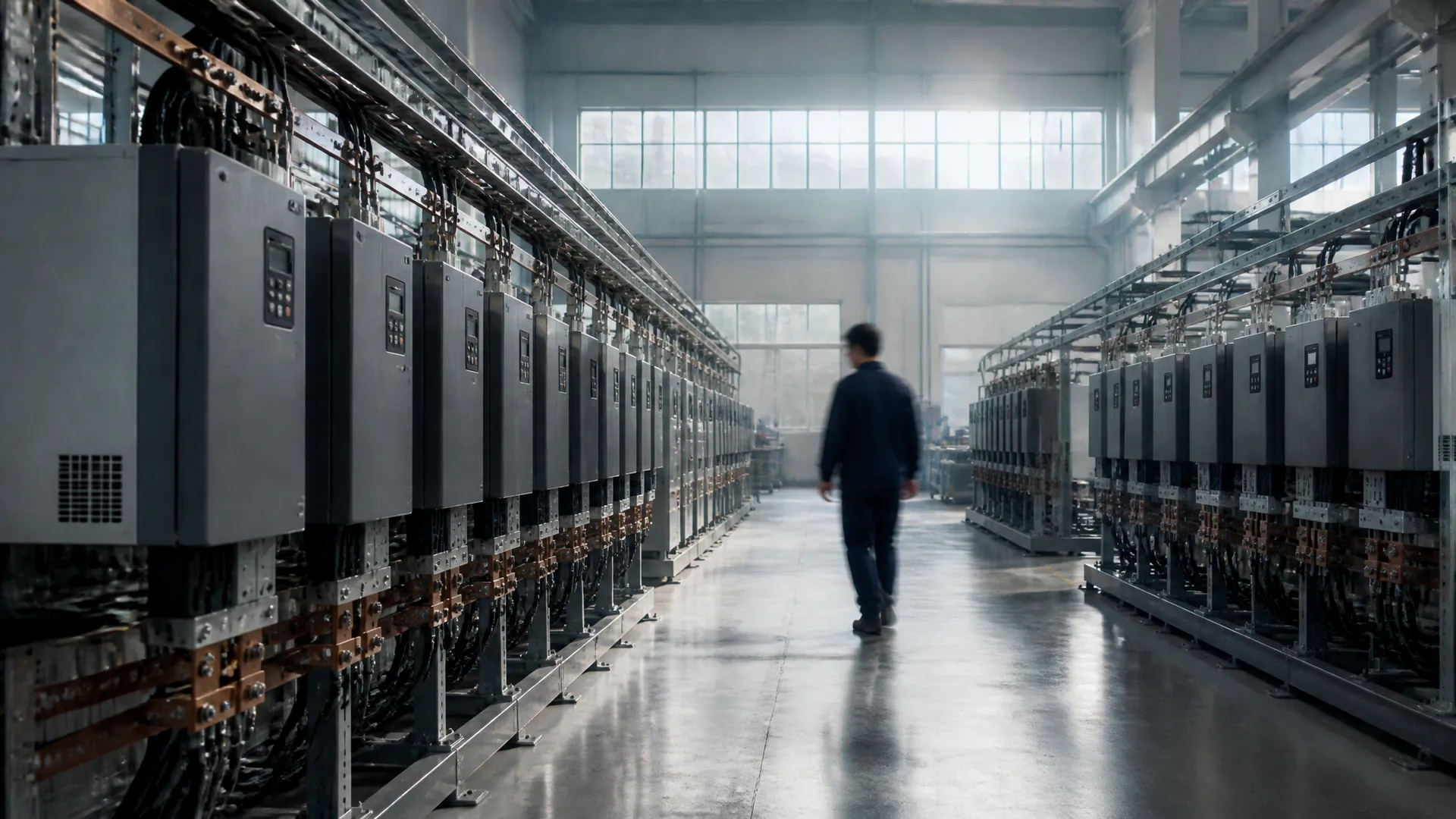
Manufacturing plant · Jiangmen, CN
English · GlobalRequest a quoteStore

Heavy and continuous · Mining and metals

Heavy-duty drives for conveyors, crushers and slurry pumps.

Mining duty is not a power rating — it is a start. A belt that stopped full, a crusher chamber that is not empty, a slurry pump that sat with solids in the line: the drive has to break the load away before it can control it, and then run for weeks without anyone walking up to it.

Belt conveyor duty on a Goldbell heavy-duty vector drive
Conveyor duty · S-curve acceleration, DC braking without a resistorG500-G/P · loaded start

This industry at a glance

SeriesG600 / G500
Frame ladder0.75–900 kW · 220 V or 380 V
Overload150% for 60 s (G rating) · 120% for 60 s (P rating)
ControlSVC · V/F · closed-loop VC
EnclosureIP20 standard · cabinet builds to order
Lead time10 days, 1–5,000 pieces

A frame number is issued against the load curve — belt data, chamber data or the pump curve — not against the motor nameplate.

Platforms used for this industry

Who does what

Three parties, three jobs.

This page states the duty and the frame rule. The commercial layer sits with whoever supplies the drive, so the split below is the one that applies whether the unit is bought from us directly or through a distributor.

The factory

What Goldbell does

  • Confirms the frame against your load curve — belt data, chamber data or pump curve, not the motor nameplate
  • Loads the parameter set for the duty before dispatch, and ships a test sheet carrying the unit serial
  • Holds board kits, keypad and parameter recovery for the service life of the code
  • Returns a written failure analysis to the supply account when a unit comes back
  • 12 months factory warranty, issued to the account that bought the unit
Your supplier

What your supplier does

  • Quotes the frame, the options and the freight in your currency
  • Dates the build — 10 days for 1–5,000 pieces once the specification is agreed — or ships from the 0.75–75 kW band he stocks
  • Commissions the drive and trains the people who will run it
  • Owns the warranty claim and the end-customer relationship
  • Decides what is stocked locally, so a spare is a phone call rather than a shipment

The plant

What you get

  • A frame number with the reason attached, so the next size up is a decision rather than a habit
  • A unit that arrives with your duty parameters already in it
  • The G rating — 150% for 60 seconds — sized for a loaded start, not for a catalogue headline
  • One account to call, in your language, holding both the drive and the spare

What this duty actually asks of the drive

A conveyor at rest is a friction problem, not a speed problem. The starter has to break a full belt away from the rollers, which draws more current than the same motor draws at running speed — so the frame is chosen one step above the motor rating, and the overload setting is what makes that choice survivable rather than marginal. On this platform the G rating carries 150% for 60 seconds, which is the window a loaded conveyor actually needs.

A crusher is the opposite shape of problem. The breakaway torque is high and the load is uneven, so current limiting has to hold the motor inside its thermal capacity while the chamber empties, instead of tripping on the first surge. That is a parameter question more than a hardware question: the ramp, the current limit and the overload window are set together, and all three depend on the load curve the plant can supply.

The third duty is the one nobody photographs: weeks of continuous running. At that point the limiting factor stops being the electronics and becomes heat — the room, the dust loading, the cooling path — which is why the enclosure is quoted against the installation rather than picked off a table by industry.

How the frame is chosen

Duty conditionFrame ruleWhat gets set
Belt conveyor, loaded startOne frame up; G ratingS-curve acceleration, DC braking without a resistor option
Crusher feed, uneven breakaway torqueOne frame up, confirmed on the load curveCurrent limit and ramp set to the motor thermal capacity
Slurry or process pump, variable torqueFrame at motor rating — torque falls with the square of speedPID pressure loop, soft-start ramp
Long cable run to a remote conveyorFrame unchanged; cable sized on the voltage dropCarrier reduced to 4 kHz or below
Duty above 900 kWQuoted per frame, not read off a tableQuoted against the load curve and the supply

Send the load profile — belt data, chamber data or the pump curve — and the rating is confirmed on it. The same rule is stated on the duty profiles.

The four data points

What your supplier needs before he can confirm a frame.

A drive matched to a nameplate instead of a load curve is the usual reason a first start trips. These four lines are the whole of what is needed for a conveyor; a crusher adds the chamber, a pump adds the curve.

  1. Belt or conveyor: centre-to-centre length, incline in degrees, tonnes per hour
  2. How the machine starts: empty or loaded, how many times an hour, and what it does after a trip
  3. Motor: nameplate kW, voltage, rated current, and whether it is inverter-duty
  4. Site: ambient temperature, altitude, cable run from the panel to the motor, and whether dust or water is present

Ready to send

Duty point for a drive quotation — please confirm the frame against this:
1. Belt: length ___ m, incline ___°, throughput ___ t/h
2. Start: loaded / empty, ___ starts per hour, restarts after a trip: yes/no
3. Motor: ___ kW, ___ V, ___ A, inverter-duty: yes/no
4. Site: ambient ___ °C, altitude ___ m, cable run ___ m, dust/water: ___

Paste it into your enquiry, or into the form below, and the frame comes back confirmed rather than estimated.

Where this platform stops

A page that claims to cover every case is worth less than one that says where the catalogue ends. These four decide whether the answer is a standard frame, a cabinet build, or a different supplier.

IP20 is the standard protection grade. A cabinet build is quoted against the room it stands in, and the dust and ambient figures behind that build are confirmed on the drawing — this site publishes no per-industry derating table, and inventing one would be the easiest lie on the page.
No hazardous-area certification is in the current dossier. CE LVD/EMC (attested by UDEM) and ISO 9001 (STC 78623Q0124R0S) are what exist; neither covers explosion protection, so an ATEX or IECEx installation needs the motor, the enclosure and that certificate from a supplier who holds it.
Above 900 kW the published frame ladders end. Wider frames are quoted per frame rather than listed, so a duty that size goes to the RFQ with the motor rating and the load curve.
No mining references are published. No customer name, plant name, site photograph or installed-base count appears on this page, because a reference that cannot be verified is worth less than none.

Packing, crates and loading

What arrives, and what the box measures.

A plant that has agreed the frame still has to receive it: clear the crate, get it through a door, and find room for the spares. The G500 ladder is the one whose pack footprint is published against every frame, so the volumes below are arithmetic on published millimetres rather than a second set of figures. Crate builds and loading are confirmed on the packing list for the shipment.

G500 Heavy-Duty Vector Drive — pack footprint as published, volume calculated from it
ModelPack footprintCBM / unitShips in
G500-S0.75G0.75 kW (1-φ 220 V)190 × 130 × 170 mm0.0042Export carton
G500-4T5.5G / 7.5P5.5 / 7.5 kW (380 V)290 × 185 × 240 mm0.0129Export carton
G500-4T15G / 18.5P15 / 18.5 kW (380 V)390 × 290 × 290 mm0.0328Export carton
G500-4T45G / 55P45 / 55 kW (380 V)520 × 350 × 310 mm0.0564Export carton
G500-4T110G / 132P110 / 132 kW (380 V)——Export wooden crate
G500-4T315G / 355P315 / 355 kW (380 V)——Floor cabinet build
G500-4T800G / 900P800 / 900 kW (380 V)——Engineered cabinet unit

The volume column is the pack footprint multiplied out — nothing else. Multiply it by your quantity to get the space you are booking, then add a margin for pallet and dunnage. Serial numbers are printed on the carton and the crate, and the serial-to-carton mapping is retained for warranty traceability.

The carton runs to 45 / 55 kW

On the G500 ladder the four smaller frames leave in an export carton, and the footprint on each is the one printed above. From 110 / 132 kW the unit ships in an export wooden crate; above that the frame is a floor cabinet or a modular assembly, and the crate is built for that frame rather than chosen from a size.

A crate is built to the frame, not picked off a shelf

The 315 / 355 kW and 800 / 900 kW frames are cabinet assemblies, so the crate, its base and its lifting points are made for the frame being shipped and confirmed on the packing list before the container is booked. That is also why the catalogue prints no crate size for them.

Loading is returned with the packing list

Send the mix and the destination port and the reply carries the loading plan: units per carton, crate outer dimensions, gross weight and the container breakdown. Those four numbers only exist once the frame is fixed, which is why they are not printed as a table that would be wrong for most orders.

What this page does not print

Gross weight, units per carton and the outer dimensions of a crate are not in the published catalogue. A weight typed into a web page is a number nobody weighed, and on a crate it is the number a freight forwarder prices against.

Gross weight per unit and per crate — not in the published catalogue, so not printed here.
Units per carton — it follows the frame and the inner packing, and is confirmed per order.
Outer dimensions of a crate above 45 / 55 kW — measured on the frame actually being shipped.
Pallet or loose loading — decided by the container plan for that shipment, not by the model code.
  1. Models and quantities, written out by code — G500-4T45G × 12, G500-4T110G × 2
  2. Destination port, and the Incoterm the quotation is on
  3. Carton or crate, if the receiving plant has a preference
  4. Whether the shipment has to be palletised for a rack, or can load loose

Ready to send

Packing and loading request:
1. Models: ___ (code × quantity)
2. Destination port: ___
3. Incoterm: ___
4. Packing: palletised / loose / no preference
5. Site constraint: door height ___ m, forklift capacity ___ t

It comes back with the packing list for that mix: units per carton, crate dimensions, gross weight and the container breakdown.

Questions that come before a purchase order

A 250 kW conveyor motor: which frame?

The motor nameplate does not decide it. A loaded belt start puts the conveyor duty one frame above the motor rating, and the frame is confirmed against the belt data — length, incline, tonnes per hour, how often it starts and whether it can be started empty. Send those four and the frame comes back confirmed rather than estimated.

Can the drive restart a belt that tripped fully loaded?

That is what the G rating is for: 150% for 60 seconds, with S-curve acceleration and DC braking so the belt is brought up without a shock load. A belt that tripped full is also the case where the one-frame-up rule stops being optional — a frame at exactly the motor rating has no headroom left for the breakaway.

Do you supply the enclosure and the switchgear?

The drive ships as an IP20 wall-mount unit, and cabinet builds are quoted to order against the room, the cooling path and the incoming protection. The cabinet’s own rating is confirmed on the drawing for that project; what is published here is the standard grade and the fact that the build is available.

Is the drive available with hazardous-area certification?

No. The current dossier is CE LVD/EMC plus ISO 9001, and neither covers explosion protection. An ATEX or IECEx project needs that certification to come with the motor, the enclosure and the drive from a supplier who holds it — this plant does not, and saying so at the quotation stage is cheaper than saying it at commissioning.

What about the motor, gearbox and belt?

This page covers the drive. The motor, gearbox, belt and structure are specified by the plant or the machine builder, and the drive is matched to them — which is why the RFQ asks for the load curve rather than only the motor rating. A drive matched to a nameplate instead of a curve is the usual reason a first start trips.

What are the order terms?

One piece at sample price; private label and a parameter set loaded for your duty from 100 pieces. The published lead time is 10 days for 1–5,000 pieces once the specification is agreed, and the warranty is 12 months factory terms.

The duty pages behind this industry

Other industries in heavy and continuous

Next step

Send the duty point. Get a frame number back.

Power, voltage, load type and the number of units is enough to quote. Anything short of that gets a question back the same working day.

≤ 3 h
Reply on a working day
1 pc
Minimum order
10 days
Lead time to dispatch
CE LVD/EMC
ISO 9001 plant