
Blowers & Compressors
Drives for blowers, compressors and chillers.
Constant-torque loads with a hard start: torque boost at low frequency carries the breakaway, and over-excitation braking stops the rotor without a mechanical brake on the shaft.
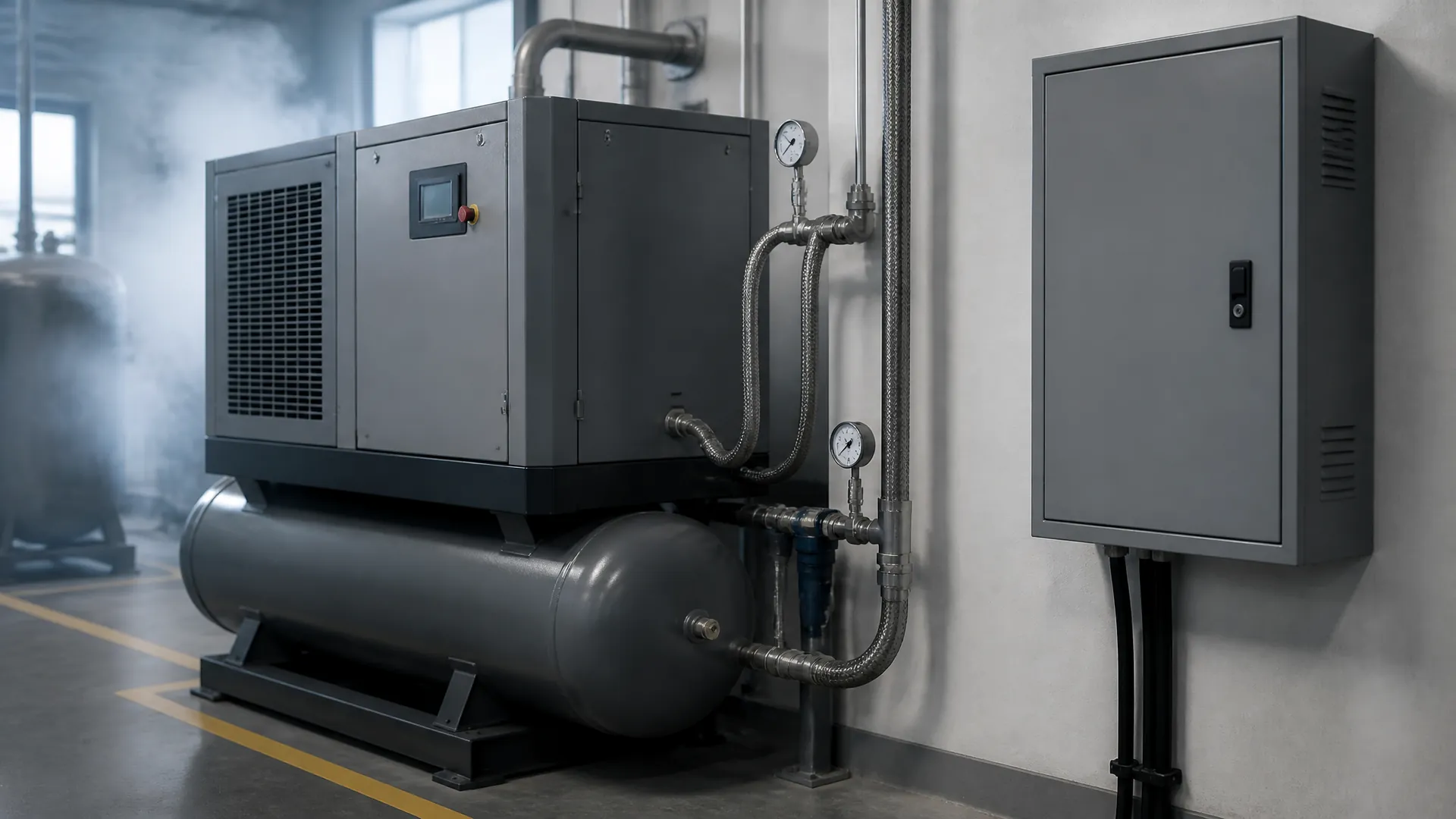
This duty at a glance
A frame number is only issued against the duty point: send the curve, the cycle or the belt data and the rating comes back confirmed, not estimated.
Platforms used for this duty
What this duty actually asks of the drive
A rotary blower or screw compressor needs a large breakaway torque and then a torque that stays flat as speed rises. A V/F curve tuned for a pump will stall on that start, which is why the torque boost at low frequency is set on the enquiry rather than left at the default.
The stop is the second problem. A compressor rotor has enough inertia to keep turning long after the run command drops, and a mechanical brake is expensive to maintain. Over-excitation braking uses the motor windings to stop the shaft through the drive instead.
Chillers and packaged units add a control requirement: the drive is usually one part of a package with its own controller, so the interface — Modbus or hard-wired — is agreed before the panel is built.
How the frame is chosen
| Duty condition | Frame rule | What gets set |
|---|---|---|
| Rotary blower, unloaded start | G rating at motor kW | Torque boost set, ramp matched to the discharge valve |
| Screw compressor, loaded start | One frame up | SVC at low speed, current limit raised to the G rating |
| Chiller or packaged unit | G rating, interface agreed first | Modbus map or hard-wired I/O schedule confirmed |
| High-inertia stop | Frame unchanged | Over-excitation braking enabled, stop time set |
Frame numbers are issued against the duty point, not against the motor nameplate. Send the load profile — curve, head, cycle or belt data — and the rating is confirmed on it.
Where this platform stops
A page that claims to cover every case is worth less than one that says where the catalogue ends. These are the limits that decide whether the answer is a standard frame, a cabinet build, or a different platform entirely.
Questions that come before a purchase order
What does over-excitation braking actually do?
It raises the flux in the motor windings at stop so the rotor energy is dissipated as heat in the motor instead of in a resistor. The shaft stops under control without a mechanical brake, which is why it is used on compressor and blower rotors with high inertia.
Can one drive serve a package with its own controller?
Yes, and the interface is agreed before the panel is built: RS-485 Modbus RTU where the package controller speaks it, hard-wired run/fault/analog where it does not. The register map or the I/O schedule comes with the quotation.
How much headroom do frequent starts need?
The G rating allows 150% for 60 s. A duty cycle with repeated loaded starts spends that window every cycle, so the frame is chosen with headroom — send the cycle profile and the frame is confirmed against it rather than against the nameplate.
Do you build the compressor panel?
The site publishes drives and cabinet builds on the G500 frames, not packaged compressor panels. IP54 cabinet builds are quoted to order; the package controller stays with the OEM.
Other duty profiles
Next step
Send the duty point. Get a frame number back.
Power, voltage, load type and the number of units is enough to quote. Anything short of that gets a question back the same working day.
- ≤ 3 h
- Reply on a working day
- 1 pc
- Minimum order
- 10 days
- Lead time to dispatch
- CE LVD/EMC
- ISO 9001 plant