
Irrigation & Solar Pumping
Solar pump drives for irrigation and off-grid water.
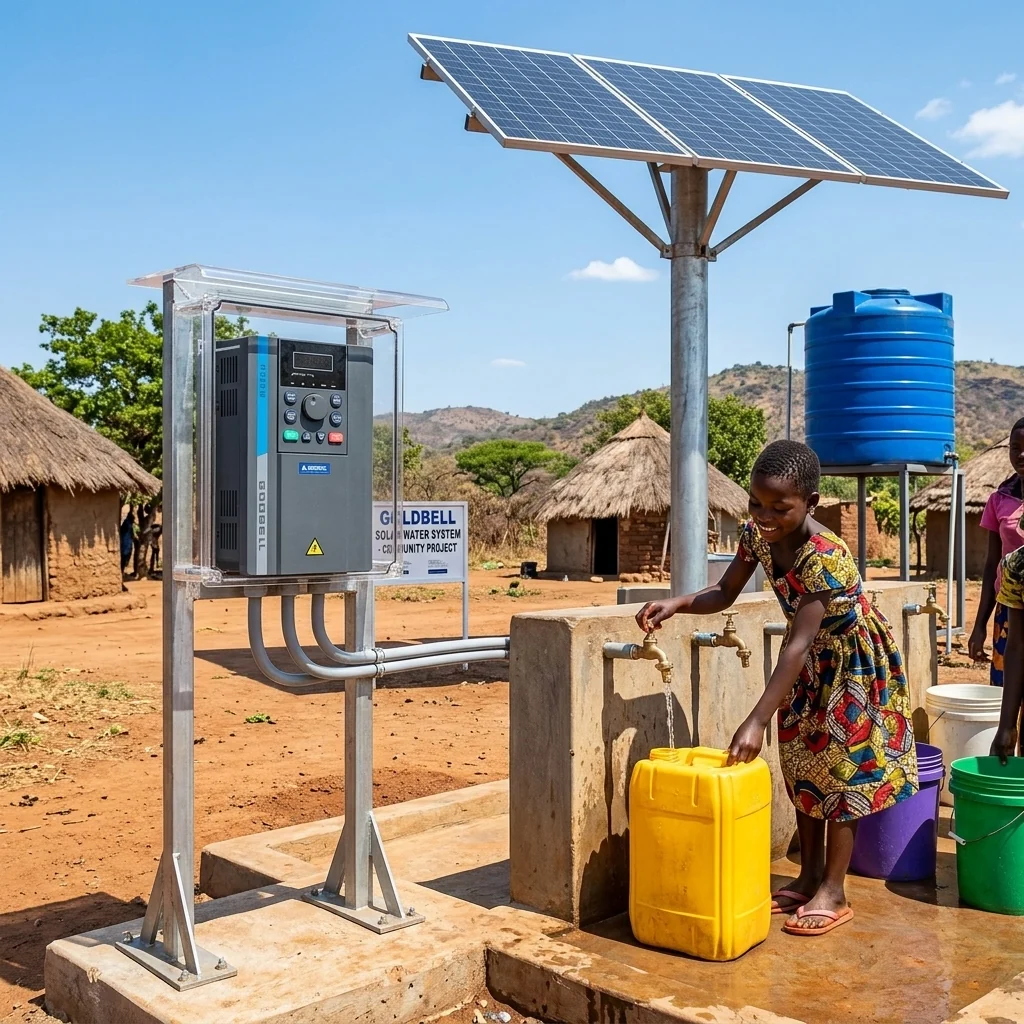
G580MPV-G tracks the array instead of the grid. MPPT sweeping, dry-run protection and 220 V or 380 V input in one chassis, so a borehole keeps delivering when the solar input falls through the afternoon.
This duty at a glance
A frame number is only issued against the duty point: send the curve, the cycle or the belt data and the rating comes back confirmed, not estimated.
Platforms used for this duty
What this duty actually asks of the drive
A solar pump is not a grid pump with a panel bolted on. The array voltage collapses under load and recovers in seconds as cloud passes, so the drive has to hunt the maximum power point continuously instead of holding a fixed V/F curve tuned for a 380 V bus that never moves.
The second difference is that nobody is standing next to it. A dry well, a fallen panel string or a low-light morning has to be handled by the drive itself — dry-run protection, low-voltage ride-through and a sleep threshold that lets the pump rest instead of stalling in the borehole.
Everything else on this page follows from those two facts: the frame is sized on the pump curve at the duty point, the parameters are set for unattended running, and the installation is specified for a site with no electrician on call.
How the frame is chosen
| Duty condition | Frame rule | What gets set |
|---|---|---|
| Centrifugal or submersible pump on MPPT | P rating at motor kW | MPPT tracking on, sleep and wake thresholds set to site head |
| Deep-set pump with a long cable drop | Frame unchanged, cable sized on drop | Carrier reduced to 4 kHz or below |
| Unattended field installation | Frame at motor rating | Dry-run and low-voltage protection enabled |
| Above the published 37 kW frames | G500 frame with the DC-to-AC solar pumping package, built to order | Quoted against the array and pump curve |
Frame numbers are issued against the duty point, not against the motor nameplate. Send the load profile — curve, head, cycle or belt data — and the rating is confirmed on it.
Where this platform stops
A page that claims to cover every case is worth less than one that says where the catalogue ends. These are the limits that decide whether the answer is a standard frame, a cabinet build, or a different platform entirely.
Questions that come before a purchase order
What is the difference between G580MPV-G and G580M?
G580MPV-G is the solar pumping build of the G580M platform: the same 4–37 kW frames on 220 V single-phase or 380 V three-phase input, with the MPPT tracking, dry-run protection and low-sunlight sleep behaviour enabled. Order it as the solar variant so the firmware and parameter set arrive pre-loaded.
Can I run the pump from the grid when the sun is down?
The drive is an AC-input unit on 220 V or 380 V, so the same chassis runs from a generator or the grid with the MPPT function off. Tell us at quotation which mode the site will use most, because the protection thresholds are set differently for each.
How is the frame chosen when the pump curve is the only data available?
Send the pump curve, the head, the array configuration and the cable drop. The frame is chosen on the duty point rather than on the motor nameplate, and the load curve is what confirms the rating — the same rule stated on the solutions overview.
What is the minimum order and the lead time?
Minimum order is 1 piece; private label and custom builds start at 100 pieces. Published lead time is 10 days for 1–5,000 pieces, and contracts, invoices and export documentation are issued by Goldbell Electric Drives and Controls (Shenzhen) Co., Ltd.
Other duty profiles
Next step
Send the duty point. Get a frame number back.
Power, voltage, load type and the number of units is enough to quote. Anything short of that gets a question back the same working day.
- ≤ 3 h
- Reply on a working day
- 1 pc
- Minimum order
- 10 days
- Lead time to dispatch
- CE LVD/EMC
- ISO 9001 plant